
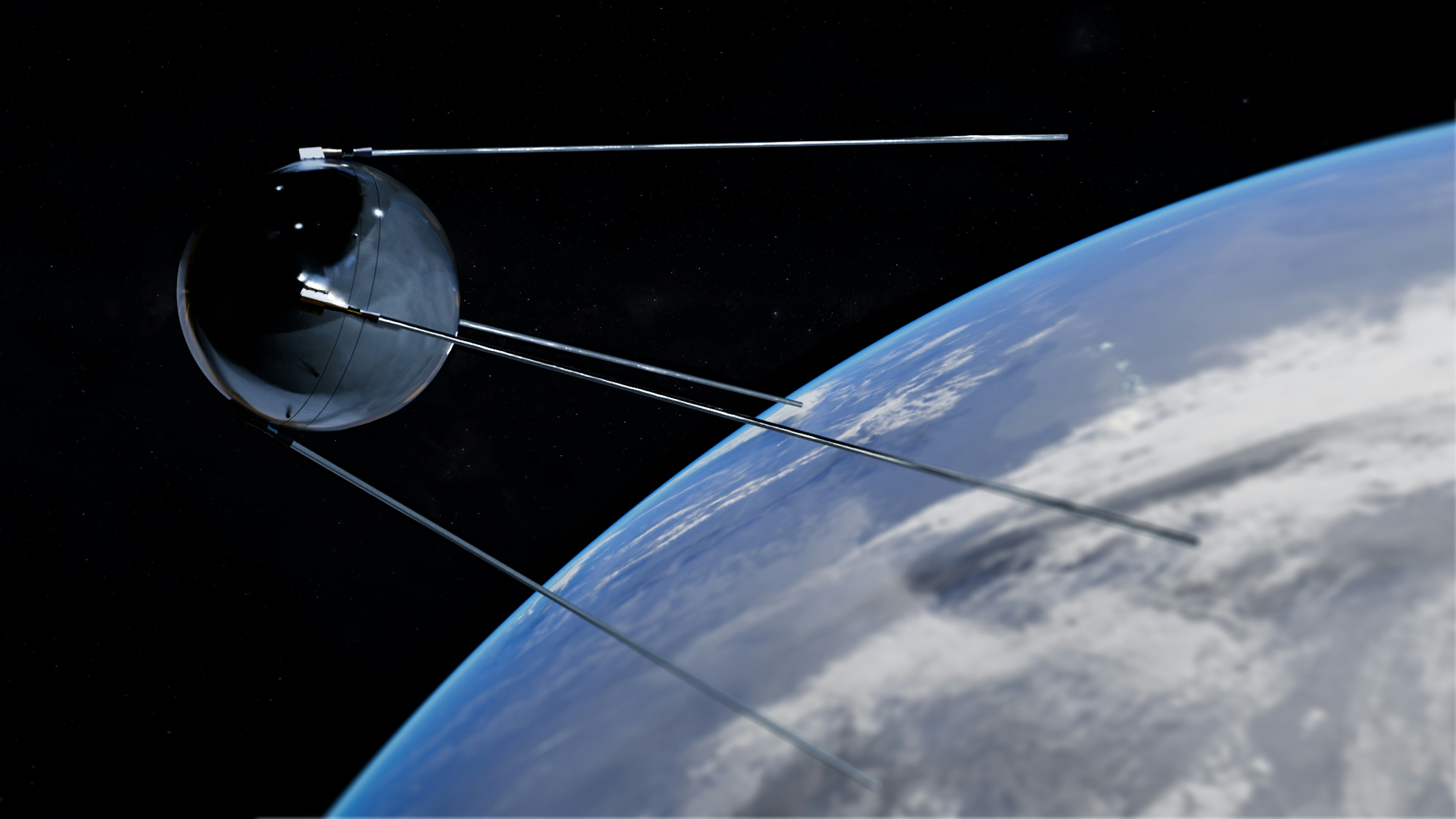
Satellites do fall toward Earth. The surprising part is that they move sideways so quickly that the planet curves away beneath them at nearly the same rate. Orbit is not a place where gravity disappears. It is a state of continuous free fall.
Orbit is falling and missing the ground
Imagine throwing a ball horizontally. A gentle throw lands nearby. A harder throw travels farther before gravity pulls it down. If you could throw it fast enough, and if air resistance did not stop it, Earth’s curved surface would drop away as quickly as the ball fell. The ball would keep circling the planet.
That is the basic idea behind an orbit. A rocket first climbs through the thick lower atmosphere, but altitude alone is not enough. It must also accelerate its payload sideways. Reaching orbit is mainly about gaining that horizontal speed.
NASA’s plain-language satellite guide describes orbit as a balance between a spacecraft’s speed and Earth’s gravitational pull. Too little sideways speed and the spacecraft comes down. Enough speed at the right altitude and its falling path keeps wrapping around Earth.
Gravity is still strong in space
A common misconception says astronauts float because there is no gravity in orbit. In reality, gravity is what holds the spacecraft in orbit. Astronauts feel weightless because they, their vehicle, and everything inside it are falling together.
This is why a crew can float aboard a spacecraft headed for the International Space Station even though the station remains close to Earth on a cosmic scale. The same principle applies to the station itself. It is not hovering. It is constantly falling around the planet.
Why satellites at different heights move differently
Low-Earth-orbit satellites travel around the planet quickly because gravity is stronger closer to Earth. Farther out, satellites can move more slowly and still remain in orbit. Their longer paths also take more time to complete.
A geostationary satellite uses a very specific high orbit above the equator. It travels in the same direction as Earth’s rotation and completes one trip in the same time Earth takes to rotate once. From the ground, it appears to stay above one location. That is useful for communications and weather observation.
Polar-orbiting satellites take a different path, passing near the poles while Earth rotates underneath. Over time, they can scan much of the planet in strips, which is valuable for mapping, weather, and environmental monitoring.
What makes a satellite come back down?
Space near Earth is not perfectly empty. In low orbit, traces of atmosphere create drag. The effect is tiny on each pass, but it gradually removes energy from an orbit. As a spacecraft loses energy, its path gets lower, where the atmosphere is denser and drag increases.
Some satellites and crewed stations periodically fire thrusters to raise their orbit. Others are designed to reenter at the end of their mission. Small objects without propulsion may decay naturally, while higher satellites can remain aloft for far longer.
A launch can also fail to produce a stable orbit. If the upper stage shuts down too early, the payload may follow a path that intersects the atmosphere. That is why “reached space” and “reached orbit” are not the same achievement. Our report on Starship Flight 14’s orbital milestone shows why the wording matters.
Can satellites collide?
Yes. Different altitudes and inclinations separate many paths, but orbit is becoming crowded. Operators track objects and can sometimes move an active satellite away from a predicted close approach. Dead spacecraft and fragments are harder to manage because they may not be controllable.
Collision risk is one reason launches, missions, and end-of-life plans must be considered as one system. A satellite is not finished the moment it reaches orbit.
The one-sentence answer
A satellite stays up because gravity pulls it down while its sideways speed carries it forward, producing a curved path that keeps missing Earth.
That simple balance explains everything from a weather satellite to the Crew-13 trip to the space station. Orbit is not the absence of falling. It is falling with exactly the right motion.