
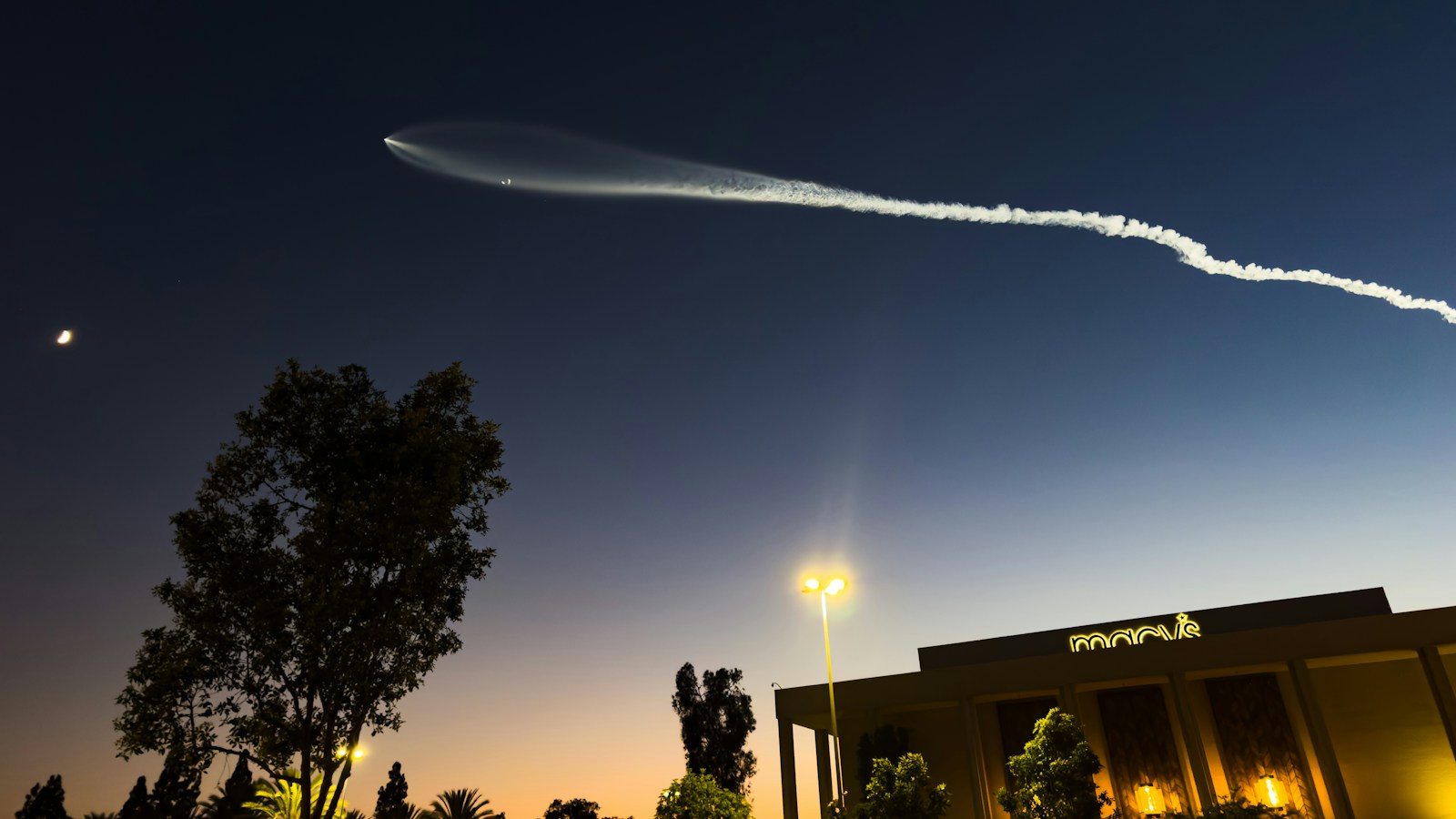
NASA’s SpaceX Crew-13 mission successfully launched from Florida on October 1 and is now traveling to the International Space Station. The Dragon spacecraft Grace lifted off at 11:10 a.m. Eastern from Cape Canaveral Space Force Station, carrying four astronauts on a long-duration science mission.
The next major milestone is scheduled for 7 p.m. Eastern, when Dragon is expected to dock autonomously with the station. If that timeline holds, Crew-13 will set a record for the fastest launch-to-docking trip by a U.S. spacecraft in International Space Station history.
What is the Crew-13 docking time?
NASA is targeting docking at approximately 7 p.m. EDT on Thursday, October 1, or 4 p.m. Pacific. Dragon will approach the space-facing forward port of the station’s Harmony module and complete the final connection automatically, although flight controllers and the crew monitor every stage of the rendezvous.
The planned trip lasts just under eight hours. NASA’s official post-launch update confirms the liftoff, crew manifest, docking target, and research program. Timing can still shift during real-time orbital operations, so NASA’s live coverage is the best place to check for a delay.
Who is flying on Crew-13?
The four-person international crew combines one experienced commander with three first-time space travelers:
- Jessica Watkins, NASA, commander: A geologist making her second spaceflight. NASA says she is the first agency astronaut to launch aboard Crew Dragon twice.
- Luke Delaney, NASA, pilot: A former U.S. Marine Corps test pilot making his first trip to space.
- Joshua Kutryk, Canadian Space Agency, mission specialist: A former Royal Canadian Air Force test and fighter pilot on his first spaceflight.
- Sergey Teteryatnikov, Roscosmos, mission specialist: An engineer and first-time space traveler.
They will join Expedition 75 aboard the station. After a short handover period, the Crew-12 astronauts are expected to depart and return to Earth, restoring the station to its usual long-duration staffing pattern.
Why is the trip to the ISS so fast?
A spacecraft does not fly straight upward to the station. It first reaches low Earth orbit, then adjusts its speed and altitude so its path intersects with the moving laboratory. The station travels roughly 17,500 mph, and launch timing must place Dragon in the correct orbital plane.
Crew-13’s nearly eight-hour rendezvous uses a compact sequence of carefully timed engine burns. That is faster than many previous Crew Dragon missions, which have sometimes taken roughly a day to reach the station. A short trip reduces the time astronauts spend strapped into the capsule, but it only works when the launch window, station position, and mission plan line up correctly.
What will Crew-13 study in orbit?
This is not a short sightseeing flight. Crew-13 is a long-duration rotation focused on station operations and science. NASA highlights three research areas with practical value on Earth and for future deep-space missions.
First, the crew will use microgravity to produce tissues derived from human stem cells. Researchers hope the work can improve disease models, personalized medicine, and pharmaceutical testing for conditions including heart disease and Parkinson’s disease.
Second, astronauts will test a mostly autonomous plant-growth system. Growing food with less crew intervention is important for long missions where space, power, water, and astronaut time are limited.
Third, the team will continue human-health experiments involving blood flow and clotting in microgravity. They will also evaluate a new in-flight diagnostic device designed to monitor astronaut health away from a fully equipped hospital.
How is Crew-13 different from a Starship test?
Crew-13 uses the operational Falcon 9 rocket and Crew Dragon system that NASA relies on to rotate station crews. It carries people and follows a tightly controlled route to the ISS. Starship is a much larger, still-developing vehicle aimed at cargo, lunar, and future deep-space missions.
That distinction is useful after the recent Starship Flight 14 orbital test. Both missions involve SpaceX, but only Crew-13 is part of NASA’s routine Commercial Crew service to the station.
What happens next?
After docking, pressure checks and hatch opening will allow the new arrivals to enter the station. The expanded crew will hold a welcome event, begin handover work, and transition into the Expedition 75 schedule. Crew-13 is expected to remain in orbit into 2027.
For viewers in the United States, the key time is 7 p.m. Eastern on October 1. The launch is complete; docking is the next event to watch.