
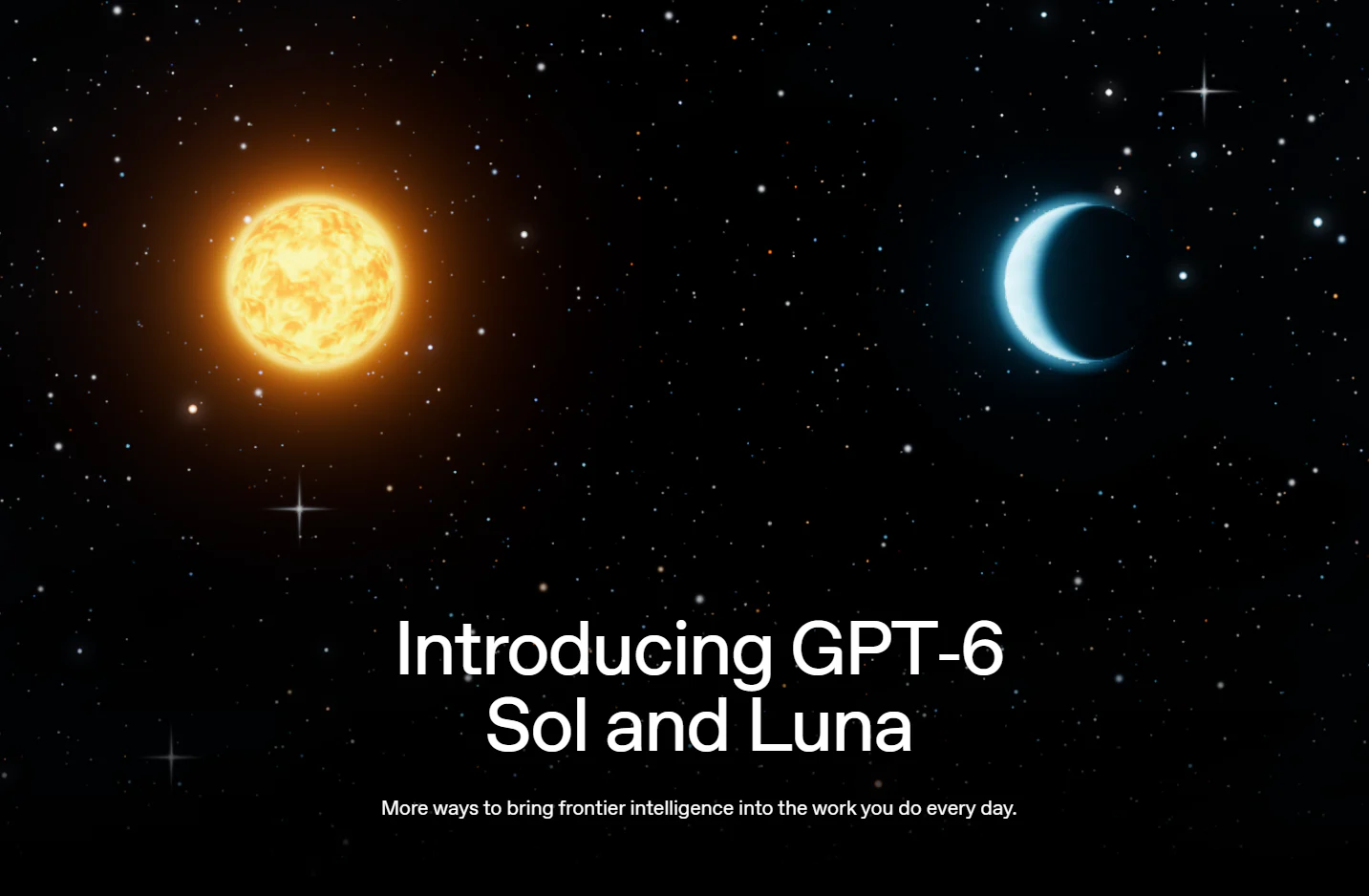
OpenAI launched GPT-6 Sol and GPT-6 Luna on September 22, expanding the GPT-6 family beyond Astra. Both models are available in ChatGPT Work and Codex for Plus, Pro, Business, Enterprise, and Edu users, while their API versions are available to developers.
The important detail is where they are available. OpenAI says Sol and Luna are not yet in the regular Chat experience. If you only check ChatGPT’s normal model selector, their absence doesn’t mean your account missed the rollout.
Sol and Luna target different levels of work
OpenAI still positions GPT-6 Astra as its best model overall and the choice for projects where maximum capability matters more than speed or usage efficiency. Sol sits below Astra as the stronger everyday workhorse. Luna is the lighter option for focused, higher-volume tasks.
That makes the new release less about replacing Astra and more about avoiding unnecessary overkill. A complex research or engineering decision may justify Astra. A substantial coding change, document analysis, or multi-step workflow may fit Sol. Repetitive transformations and narrower tasks may be better candidates for Luna.
OpenAI says both inherit improvements from Astra in professional work, factuality, coding, computer use, communication style, and alignment. Those are company-reported results, not a promise that one model will be best for every prompt or workflow.
Plus users can use them in Work and Codex
For a ChatGPT Plus subscriber, the most practical news is that Sol and Luna are included in ChatGPT Work and Codex. OpenAI also says the rollout is gradual, so it may take time for both options to appear.
This availability is separate from the OpenAI API. Choosing a model inside an included ChatGPT product does not create a per-token API bill. Developers who call gpt-6-sol or gpt-6-luna through the API are using a separately billed service.
It is also worth separating access from unlimited use. Product limits can vary with plan and capacity. The launch gives eligible users access to the models, but it doesn’t establish that every model has identical quotas.
API prices fell, but the comparison needs context
In its official GPT-6 Sol and Luna announcement, OpenAI lists Sol at $2 per million input tokens and $10 per million output tokens. Luna is listed at $0.10 per million input tokens and $0.50 per million output tokens.
OpenAI describes those prices as 50% lower than the promotional API prices for the corresponding GPT-5.6 models. That reduction applies to API usage. It should not be read as a 50% cut to a ChatGPT Plus subscription.
The company also reports a 90% discount on cached input-token reads for GPT-6. Prompt caching can reduce the cost of context that an application reuses, but the savings depend on actual cache hits rather than the mere length of a conversation.
The benchmarks are promising, not universal verdicts
OpenAI reports that GPT-6 Sol at maximum effort scored 68.8% on DeepSWE v1.1, a software-engineering evaluation. Luna at maximum effort scored 66.6%. On an internal factuality evaluation built from conversations where users flagged errors, OpenAI says Sol made about half as many mistakes as its predecessor.
Those numbers help describe the models’ intended position, but they don’t eliminate the need to test your own work. OpenAI notes that evaluations may differ from production ChatGPT because system prompts and available tools can change the result.
For connected agents, model quality is only one layer. Our guide to AI agent permissions and enforceable limits explains why a capable model still needs tightly scoped access. The related explanation of prompt injection covers the risk of untrusted instructions hidden in files or webpages.
What should you try first?
If you already use Work or Codex, Sol is the sensible starting point for most serious tasks. Move to Astra when the problem is unusually difficult or the cost of a weak answer is high. Try Luna when the task is well-defined, repeatable, and easy to verify.
The useful test is not which model sounds most impressive. Give the candidates the same real task, compare the result, and choose the least expensive or least constrained option that reliably meets your standard.